Celebrating the life of Jesus throughout the liturgical year
Editor: At the end of November, we as a church will conclude our liturgical year. Will you give us more information about why the Catholic year is different from the calendar year?
Bishop Garcia: As Catholics, our liturgical year revolves around the life of Jesus Christ. If you were to ask someone on the street, what is the most important day for a Christian, I would guess that most would say Christmas. But ultimately the highlight of the year for us as Catholics is Easter Sunday when we celebrate the Resurrection of Our Lord and Savior, Jesus Christ.
Christmas and Easter are so special that the church gives us entire seasons to prepare for each. Our liturgical year starts with the season of Advent, the four weeks prior to Christmas when we prepare our hearts not only for the birth of Christ but also for when he will come again at the end of time. As a church we celebrate Christmas from Christmas Eve until the feast of the Baptism of the Lord. This gives us time to reflect on the gift of Christ’s incarnation.
Similarly, prior to Easter, the church gives us the beautiful season of Lent, the 40 days of prayer, fasting and almsgiving during which we journey with Christ to the cross. Easter Sunday is a glorious day, and as a church we celebrate Easter for 50 days until the feast of Pentecost. In between Christmas and Easter, we have 34 weeks of Ordinary Time, during which we celebrate Christ’s presence among us.
Together, all these seasons of the church make up our liturgical year, and each season is special and has great meaning. But it is important to remember that every Sunday is special as well. As the Catechism of the Catholic Church says, “The Sunday celebration of the Lord’s Day and his Eucharist is at the heart of the Church’s life.” (CCC 2177)
As humans we tend to take for granted our liturgical feasts and traditions, but the church has given us these times to celebrate the Living God who is always with us. Just as every year as Americans we celebrate our freedom on the Fourth of July and we commemorate the lives lost on Sept. 11, throughout the liturgical year we celebrate and commemorate Christ, our Blessed Mother and the saints on their various feast days.
Editor: Each season of the liturgical year has a certain color. Tell us more about that.
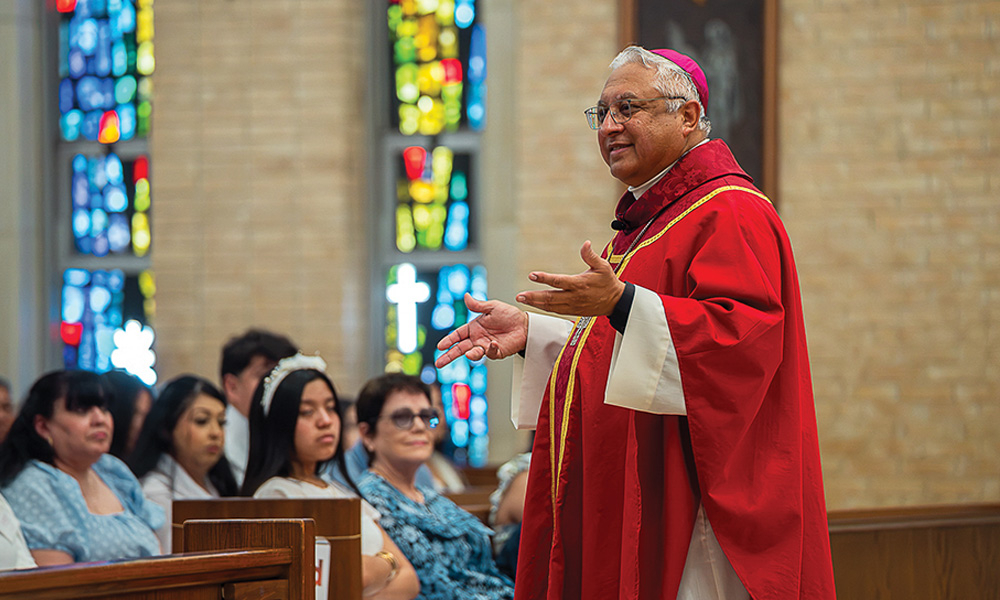
Bishop Garcia: Yes, our liturgical colors of white, red, green and violet are the color of the vestments worn at Mass, which correspond with the liturgical season that we are in. White (sometimes gold) is worn during the Christmas and Easter seasons and to celebrate feasts like Christ the King and All Saints. In Advent and Lent, the traditional color is violet. Red is worn on Palm Sunday, Good Friday and Pentecost and when we celebrate a martyred saint. Green is worn during Ordinary Time. Of course, we also may see our priests wear rose (sometimes referred to as pink) on the third Sunday of Advent and the fourth Sunday of Lent. This festive color reminds us that joy is very near. Our liturgical colors are not just decoration; traditionally, they are meant to help us enter into the mystery of each liturgical celebration.
Editor: In this coming liturgical year, we will hear often from the Gospel of Mark. Do you have a favorite Gospel?
Bishop Garcia: We have a three-year cycle of Sunday readings that we hear at Mass, and we will be in Year B in the coming liturgical year, which does focus on the Gospel of Mark. Mark is our shortest Gospel, and it was probably written first, according to Scripture scholars. The Gospels of Mark, Matthew and Luke are our synoptic Gospels, and ultimately these three Gospels are quite similar as they recount the life of Christ, his miracles and the parables he taught.
But to answer your question, if I had to choose a favorite Gospel, I would have to say it is the Gospel of John. John is very poetic and symbolic. It starts with, “In the beginning was the Word, and the Word was with God, and the Word was God.” This passage is so beautiful, and I have always been drawn to this particular Gospel.
Editor: As we wrap up this liturgical year, what is your prayer for us?
Bishop Garcia: As we have moved through this liturgical year and also the calendar year, we have experienced many difficulties. From natural disasters to personal tragedies to the misery of war, many are suffering but also many are reaching out to help their brothers and sisters in Christ. Even in the midst of chaos and crisis, we know God is present. I pray that we are the hands and feet of Christ for those around us, and I pray that our fractured and divided world will find comfort in the person of Jesus, our Lord and Savior. Amen.
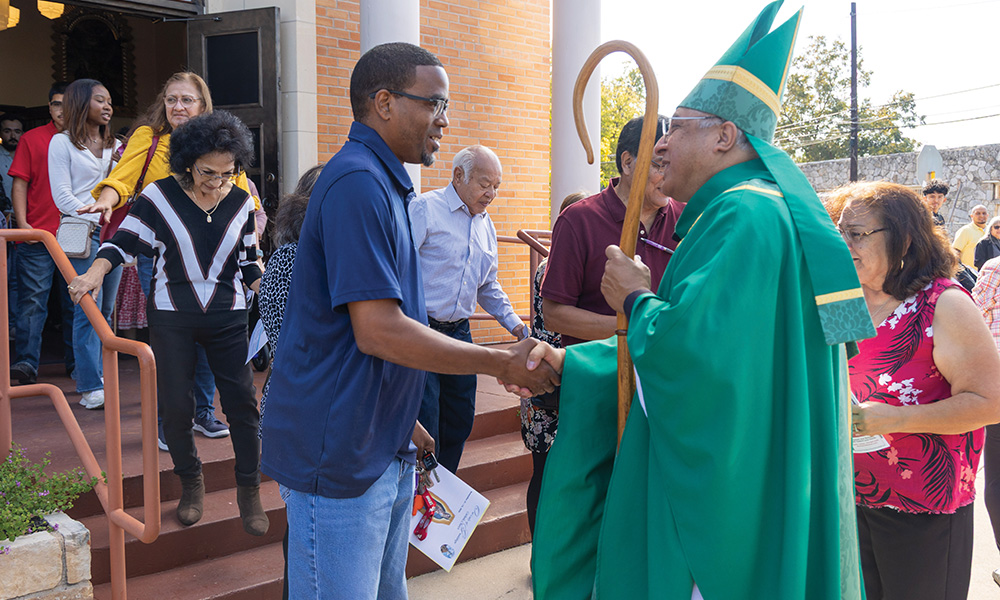
Bishop Daniel E. Garcia was installed as the sixth bishop of the Diocese of Austin on Sept. 18, 2025. The Diocese of Austin is home to more than 700,000 Catholics. For details, visit the diocesan website at austindiocese.org.