How am I ‘Simon’ to my brother in need?
In 1969, the British rock group, The Hollies, produced a hit song, “He Ain’t Heavy, He’s My Brother.” That expression has become part of our cultural lexicon communicating an important message — sometimes we have to physically carry our brothers and sisters in need and doing so does not have to be a burden. Instead, it is a reflection of Christ’s love for us when we carry one another during times of vulnerability, pain or need.
In 1969, the British rock group, The Hollies, produced a hit song, “He Ain’t Heavy, He’s My Brother.” That expression has become part of our cultural lexicon communicating an important message — sometimes we have to physically carry our brothers and sisters in need and doing so does not have to be a burden. Instead, it is a reflection of Christ’s love for us when we carry one another during times of vulnerability, pain or need.
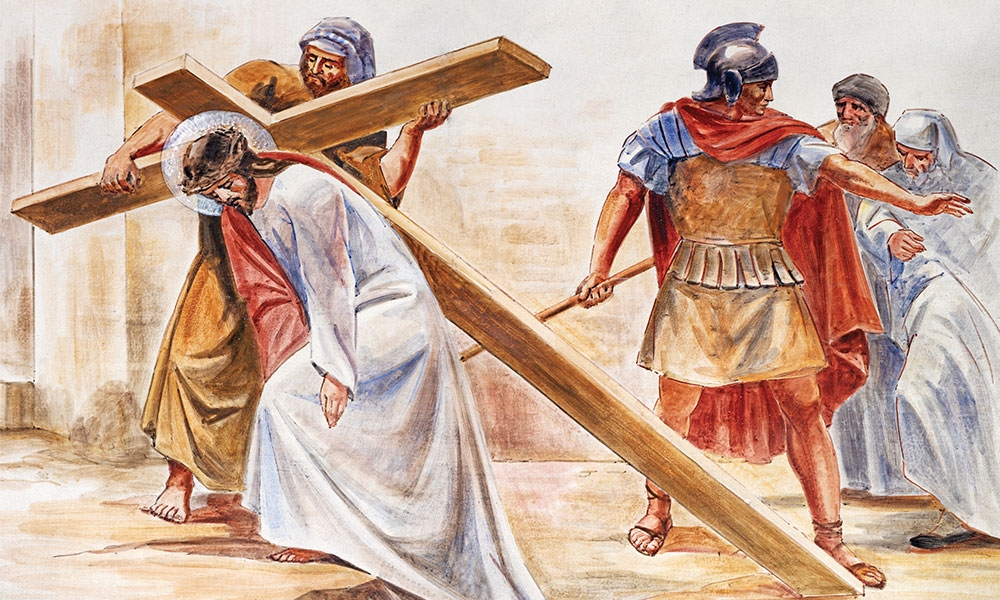
Palm Sunday’s account of the Christ’s Passion from Matthew’s Gospel includes a one-verse reference to “… a Cyrenian named Simon; this man they pressed into service to carry his [Christ’s] cross.” (Mt 27:32) Simon is there. He never speaks. He helps Jesus carry the cross. Then, he disappears back into the crowd of onlookers and is never mentioned again.
Who was Simon anyway? His title connects him to Cyrene, capital city of a Roman province on the north coast of Africa where a large number of Greek-speaking Jews lived. What was he doing in Palestine? What marked him as hailing from Cyrene? Was he working to support his family back home? Or had he traveled to Jerusalem for Passover? None of the gospels give many details about him. I like to picture Simon as an unassuming, hard-working man with calloused hands and broad shoulders, a man able and willing to help a neighbor.
A paramount question is whether Simon had a choice in carrying the cross of Christ. In Jesus’s time, a condemned man was required to carry his own instrument of destruction. Yet, the soldiers were pragmatic. Because Jesus had been severely beaten during the scourging, he was too weak and depleted to bear the heavy crossbeam. Solution? Grab a sturdy bystander and “press him into service” to help carry the load.
Resisting a Roman order could have been costly to Simon. He likely would have incurred a few lashes himself if he attempted to decline. Under duress, he allowed himself to be used by the Romans to help our suffering Savior. Instead of turning away to escape notice or shrinking back so as not to be within reach, Simon stayed close to Christ. He opened his heart with compassion and displayed a willing spirit when called upon to help. So was it the tip of a spear or a nudge from the Holy Spirit that propelled Simon? Maybe both.
In ways unique to each of us, we are all called to be a Simon to help relieve the burdens of the weak and hurting of the world when their needs beckon. As Jesus assures us earlier in Matthew’s Gospel, “whatever you did for one of these least brothers of mine, you did for me.” (Mt 25:40) Simon’s example is one of the great lessons of Lent — be willing to abandon a self-first approach to life and love each other, even strangers, as Christ intended.
The Hollies’ songwriters Bob Russell and Bobby Scott wrote some key lyrics that could well echo Christ’s sentiments while carrying his cross.
If I'm laden at all
I'm laden with sadness
That everyone's heart
Isn't filled with the gladness
Of love for one another.
After helping Christ, it’s impossible to know whether the crowd treated Simon with hostility, indifference or gratitude. Had others shown appreciation for his efforts, I imagine Simon may have simply demurred, “It was nothing, he’s my brother.”
Louis A. Gamino is a clinical psychologist at Baylor Scott White Health and a member of St. Luke Parish in Temple. Find more about him at www.LouisGamino.com.