Local iconographer’s work is written in prayer
Icons can be found on the walls of our parishes. Maybe there is one hanging in your house? Icons are a mysterious facet of the church and not well understood.
Icons can be found on the walls of our parishes. Maybe there is one hanging in your house? Icons are a mysterious facet of the church and not well understood.
For iconographer Garrett Hines of Bryan icons are not art, but a meditative, ritualized process of putting Scripture into form.
“The purpose of an icon is to help a person pray,” Hines said, adding that icons “are written not painted,” making them a ‘gift’ to people before the invention of the printing press and, by extension, mass literacy.
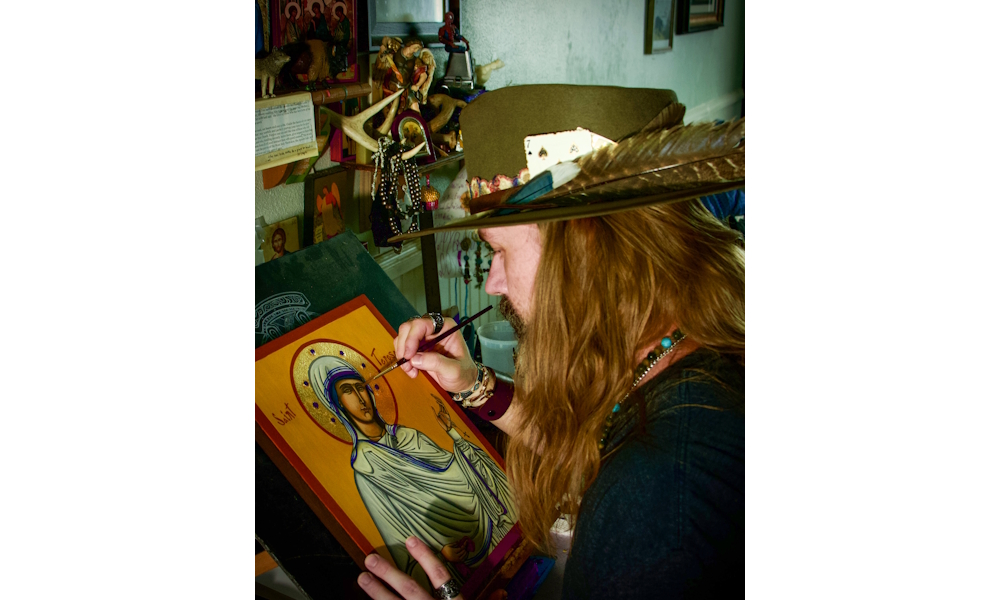
Using egg tempera, an ancient process of making paint by hand, Hines mixes egg yolks with vinegar and water. There’s a 20-minute window in which to use the paint, otherwise the pigment dries.
Before he starts applying brush to the board, he considers the patron he is making the icon for and writes a prayer into the border of the wooden board, fully aware that it will be covered. He also prays multiple Hail Marys as he is creating.
“Prayer is woven in and through every fiber,” Hines said.
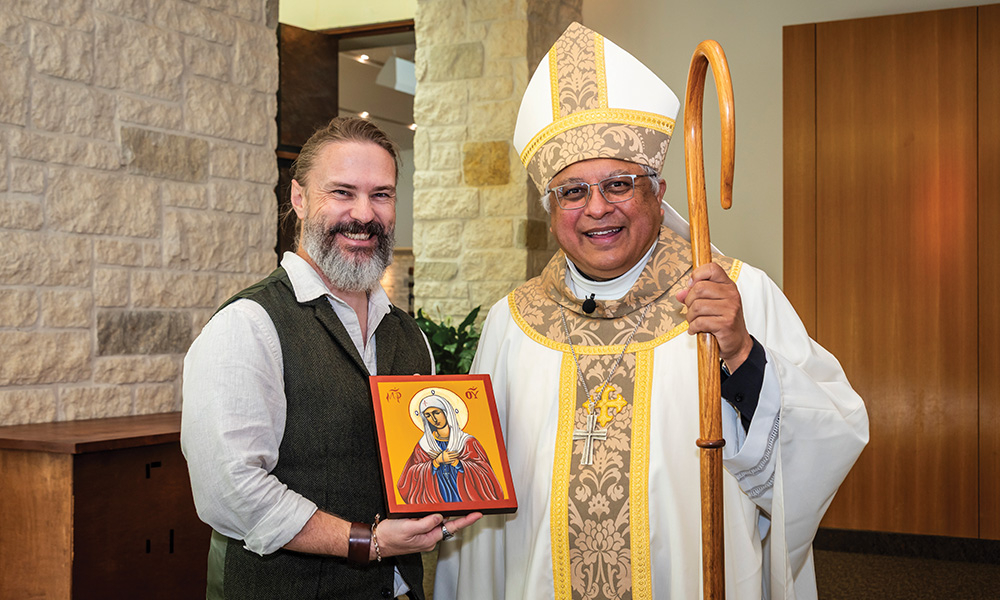
His dream is to give an icon to the first American pope, Leo XIV, and so far, he has come pretty close as he gifted icons to two Texas bishops. He gave Christ the Pantocrator to Archbishop Joe Vásquez of the Archdiocese of Galveston-Houston, and Our Lady of Humility to Bishop Daniel Garcia of the Diocese of Austin.
Hines admitted he could not have imagined he would be doing this in a million years.
Meanwhile, as a public high school art teacher in Bryan, Hines doesn’t hide his religious affiliation. His classroom walls are stacked with Rembrandts — The Sacrifice of Isaac, Christ in the Storm and Christ of the Cross, just to name a few.
He wears a cross around his neck as he walks the halls of Bryan High School. When he is not teaching students, he paints scenes from the Bible and sacred Scripture in watercolor at his desk.
“It does what it wants to do, and you're lucky if you can guide it into doing the thing that you want it to do,” he said of his art.
That’s kind of an allegory for Hines’ own faith journey since converting to Catholicism 13 years ago. Originally a Protestant missionary in Southeast Asia with his wife, Hines was drawn to a more liturgical experience.
Seeing an opportunity, his cousin suggested he consider iconography. His first attempt was a watercolor he framed and hung in his daughter’s bedroom. A customer base soon followed. “Dad, where's mine?” his son asked. He was given St. Francis not long after.
The real test of Hines’ iconographic prowess was when he put an icon of Our Lady of Perpetual Help in the auction at St. Thomas Aquinas Parish in College Station, which ended up in the middle of a bidding war.
“People … spent a little bit of money,” Hines chuckled humbly.
It was at the auction that Father Albert Laforet, pastor of St. Thomas Aquinas Parish, saw his work, and offered to send him to an iconography workshop taught by master iconographer Veronica Royal. However, this wasn’t just an act of generosity or casually veering someone into a hobby. This was a serious mission.
“I want you to go do this and then come back and teach us,” Hines recalled Father Laforet saying. “I want our parishioners to know more about iconography.”
Since coming back, Hines has done just that: he gives lectures to the youth on iconography and teaches about the intercession of the saints and icons at OCIA (Order of Christian Initiation of Adults) events.
He aspires to use his work to help people grow in their faith, and he hopes he can make iconography his full-time job.
Ultimately, he sees icons as a respite for people’s spiritual journey that can be passed down through generations.
“Knowing that I get to create a sacrament that these people will incorporate into their prayer for the rest of their life and, Lord willing, for their children's lives … that’s a wild opportunity,” Hines said.
Since his popularity has grown and the demand for his work has increased, Hines is continually asked why he won’t sell prints of his work and felt it was necessary to address it in a YouTube video.
“If I spend all those hours in prayer for you, and praying into this icon, which becomes a window into heaven for you, that blessing does not transfer to a copy,” Hines said. “It is a very real and very tangible way in which you encounter the kingdom of God.”
He said his full immersion into the craft of iconography can be credited to only One.
“God made it happen,” Hines said.
For more information about Garrett Hines’ work, visit garretthines.com.
Martin Friedenthal is a doctoral student in Texas A&M University's Department of Communication and Journalism. His writing has appeared in multiple Dallas-Fort Worth publications, covering topics from religion and education to local history and government. He is a parishioner of St. Mary Catholic Center in College Station.