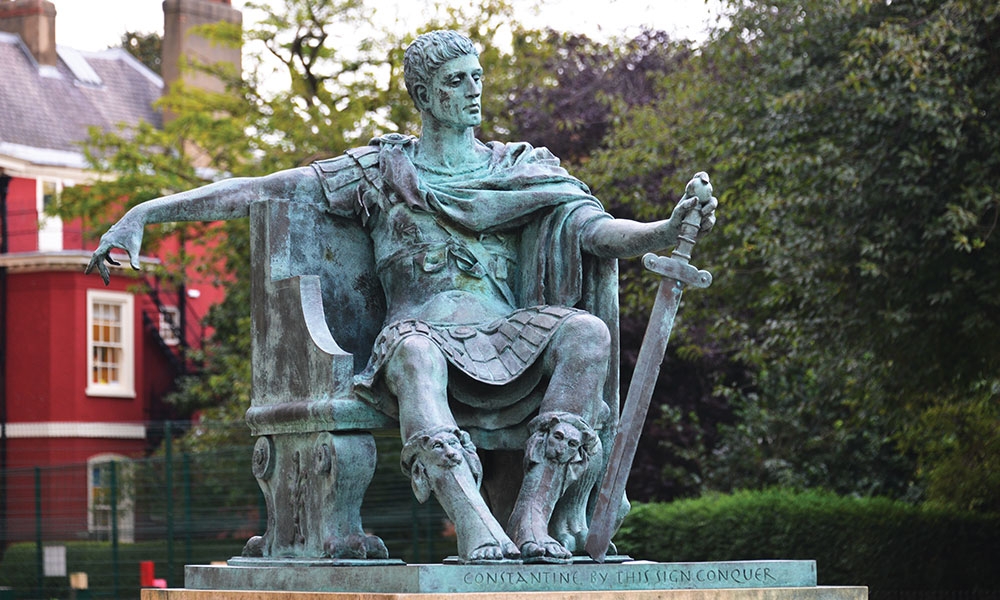
St. Constantine was first Christian emperor of the Roman Empire
It was the year 312, and the new Roman emperor, Constantine the Great, was preparing for a decisive battle against his rival Maxentius. He had been proclaimed emperor after the death of his father, Constantius Chlorus, in battle in 306.
It was the year 312, and the new Roman emperor, Constantine the Great, was preparing for a decisive battle against his rival Maxentius. He had been proclaimed emperor after the death of his father, Constantius Chlorus, in battle in 306.
He implored his god, Apollo, to favor him with a victory and with a sign. But Apollo kept silent. Rene Fulop-Miller relates what happened next in The Saints That Moved the World.
“Suddenly in the cloudless blue of the sky above, Constantine saw what he knew to be the symbol of faith adopted by the Christians. Underneath this flaming vision, he read these words, written in fire: By this, conquer!”
He faced the army of his rival and won the battle at the Milvian Bridge near Rome in 312. He concluded that the God of the Christians had won the victory for him and adopted the cross as his device. Fulop-Miller writes that the first two letters of the name of Christ were inscribed in Greek on the imperial standard and written on the shields of the soldiers.
In the following year Constantine promulgated the Edict of Milan, which became the famous edict of toleration that officially put an end to Roman persecution of Christians and granted them full protection and free public worship.
During his early years when he was growing up in the court of Diocletian and serving in the military, Constantine combined both paganism and Christianity into his personal life and political affairs. He had been born around 274 at Naissus to Constantius Chlorus, a Roman officer who became emperor, and St. Helena, who was described as a woman of inferior lineage.
After the battle at Milvian Bridge, Constantine continued to face opposition from other rivals, and by 325 he defeated his fourth rival, Licinius, and became sole emperor. Editor Dom Basil Watkins, OSB, writes in The Book of Saints that Constantine presided over the first ecumenical council at Nicaea in 325.
In 326 Emperor Constantine I ordered Christian bishops to find the sites of Christ’s passion and ordered shrines and churches to be built there. According to Tessa Paul in the Complete Illustrated Encyclopedia of Saints, the Holy Sepulcher was built by Constantine himself and stands to this day. He also built the old St. Peter’s Basilica.
It has been said that Constantine supported the church financially, granted privileges to clergy, promoted Christians to high offices and returned property that had been confiscated during the long period of persecution.
In 330 he established Constantinople (now Istanbul) as a new Christian capital for the empire. Dom Watkins states that it remained the greatest city in Christendom for a thousand years.
As he got older, Constantine became increasingly Christian but did not receive baptism until he was on his deathbed. He was the first Roman emperor to convert to Christianity. His mother, St. Helena, also a convert, founded churches in the Holy Land, which drew more pilgrims.
Constantine died in 337. He is commemorated annually as a saint by most Eastern Christian Churches and is also known as the “Thirteenth Apostle.” He and his mother, St. Helena, are commemorated on May 21.
Mary Lou Gibson is a freelance writer who loves to explore the lives of saints. She is a member of St. Austin Parish in Austin.